Hydration Breaks at the 2026 World Cup: Has FIFA Gone Too Far?
FIFA defends hydration breaks as a player welfare measure, but the backlash is growing. France vs Iraq, played in rain and interrupted by severe weather, made the debate even more controversial.
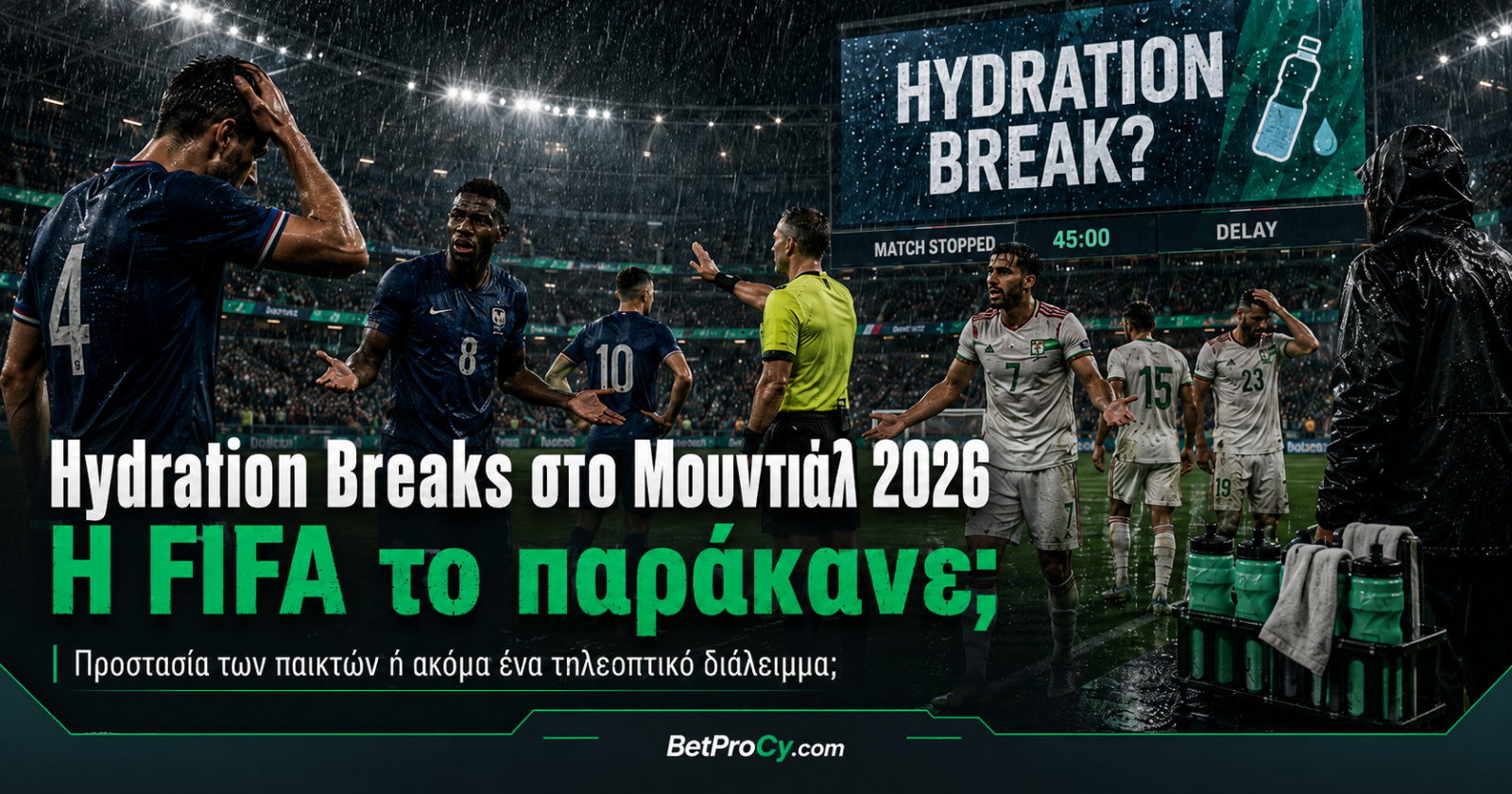
The 2026 FIFA World Cup is bigger, louder, more commercial and more global than ever before. But among the goals, drama and massive stadiums, one issue has started to create real backlash: mandatory hydration breaks.
FIFA has introduced three-minute hydration breaks around the middle of each half, regardless of the stadium, city, temperature or weather conditions. Officially, the reasoning is simple: player welfare. And of course, nobody can argue against protecting footballers in extreme conditions.
But that is exactly where the debate begins.
At what point does protection become overregulation?
There is a huge difference between playing under extreme heat and humidity, where a pause can genuinely protect players, and stopping every single match simply because the rule says so. Football is not an American football game. It is not basketball. It is not designed around constant scheduled interruptions. It is built on rhythm, momentum, pressure, mistakes, emotion and flow.
And one of the most bizarre examples came during France vs Iraq.
The match was played in difficult weather conditions, with rain and storms affecting the game. It was eventually interrupted because of severe weather. So while the issue on the night was not heat, but bad weather and rain, the wider discussion around hydration breaks became even more absurd. After the long delay, the next hydration break in the second half was cancelled.
And that raises a fair question.
If the break is so essential, why can it be cancelled after a long stoppage? If it is truly about player safety in every situation, why is it not based on the actual conditions of each match? And if it can be adjusted, why not make the decision case by case from the beginning?
FIFA argues that the measure creates consistency for all teams. On paper, that sounds fair. But fairness does not always mean applying the exact same rule everywhere. Sometimes fairness means making the right decision based on the real conditions.
Miami heat is not the same as a rain-soaked match. A humid afternoon is not the same as a cooler evening. A game played under brutal sun is not the same as one interrupted by storms. Football has always been shaped by different environments, and that is part of its identity.
The bigger issue, however, is not only the break itself. It is what surrounds it.
When the match stops for three minutes, a window opens. And in modern football, every window becomes a product.
TV spots. Sponsors. Commercial messages. Betting brands. Live odds. Promotional graphics. The World Cup is already the biggest sporting product on the planet, and betting advertising is now everywhere: before matches, during halftime, across social media, in broadcast graphics, in pre-game shows and post-game analysis.
So the question is unavoidable: are hydration breaks only about protecting players, or are they also a new golden opportunity for television and commercial exposure?
To be fair, not every hydration break is wrong. In extreme heat, they are necessary. In difficult conditions, they can protect players and help maintain the level of the match. Nobody wants to see footballers pushed beyond safe physical limits.
But making them mandatory everywhere, without properly judging the actual conditions, feels like another step toward a version of football that is more controlled, more commercial and less natural.
That is why fans are reacting.
Fans understand when a measure makes sense. But they also understand when something starts to look convenient for everyone except the game itself.
How much more will football’s rhythm be interrupted to fit the product? How much more will the sport change to suit television? And how far can FIFA go before the game starts losing what made it unique in the first place?
Football needs protection. Players need care. But the game also needs balance.
Because when every match starts to feel like it is being split into four parts, when every stoppage becomes a chance for advertising, and when hydration breaks are still part of the conversation even during rain and weather delays, maybe we are no longer talking only about player welfare.
Maybe we are talking about the changing identity of football.
And that should concern everyone.