World Cup 2026 Cards: Fewer Yellow Cards Than Qatar 2022, But More Decisive Refereeing Calls
The first 20 matches of the 2026 World Cup reveal an interesting trend: fewer yellow cards compared to Qatar 2022, but already several major refereeing decisions. We analyze the numbers and what they mean for card betting markets.
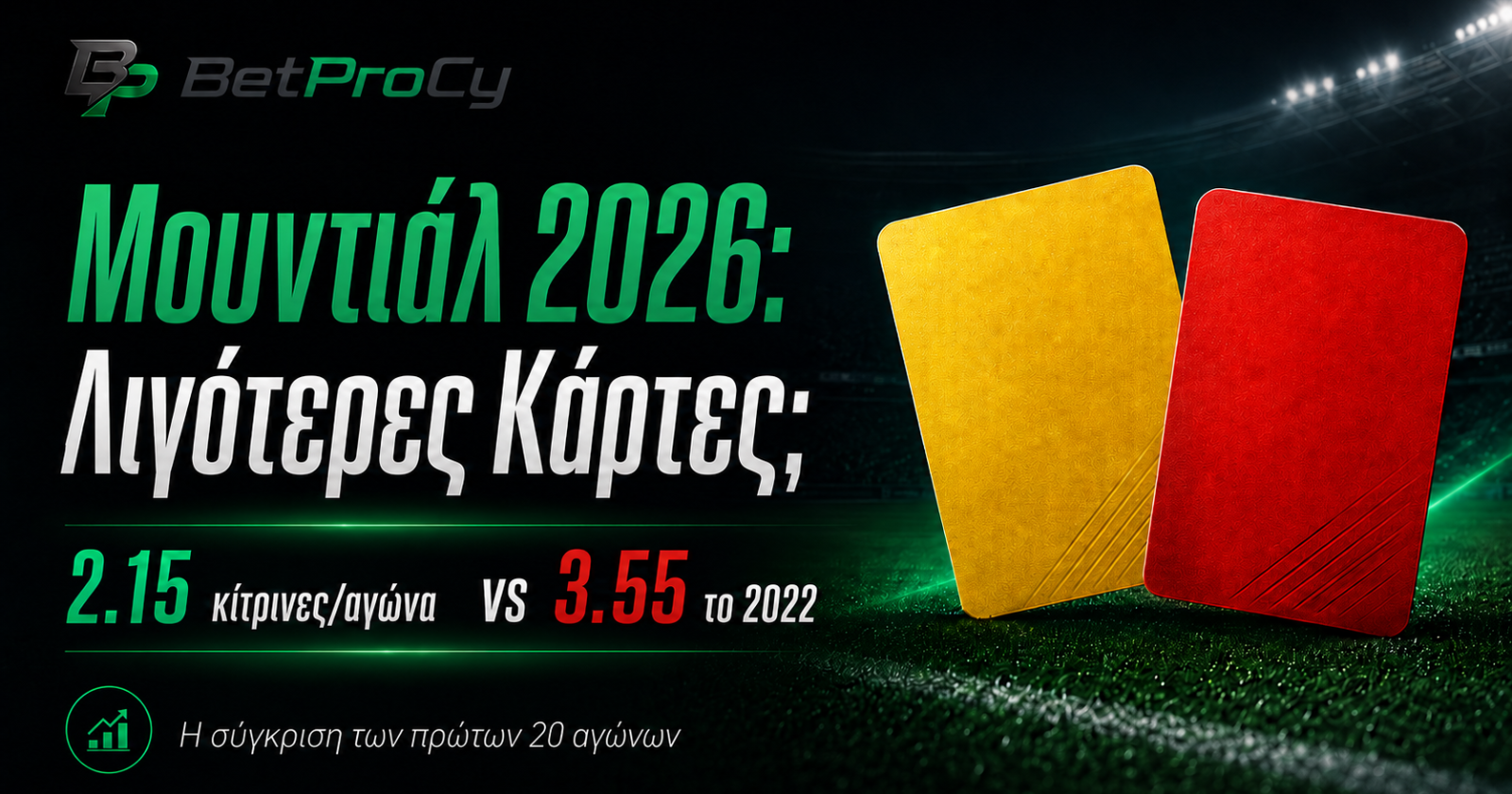
The 2026 World Cup is still in its early stages, but the first card statistics are already showing a very interesting pattern. After the first 20 completed matches of the tournament in the United States, Canada and Mexico, the average number of cards is noticeably lower compared to the 2022 World Cup in Qatar.
The early numbers suggest a tournament with fewer yellow cards per match, meaning fewer frequent disciplinary interruptions. At the same time, however, red cards have already made their presence felt, creating an interesting contrast: fewer warnings, but more decisive refereeing decisions in the small sample of the opening games.
For football fans, this is a useful statistic to understand the rhythm and refereeing approach of the tournament. For bettors, especially those who follow card betting markets, it is a trend that deserves careful attention.
The Numbers From the First 20 Matches of the 2026 World Cup
Based on the card count from the first 20 matches of the tournament, we have seen:
- 43 yellow cards
- 3 red cards
- 46 total cards
This means the 2026 World Cup currently averages:
- 2.15 yellow cards per match
- 0.15 red cards per match
- 2.30 total cards per match
The most important figure here is the yellow card average, because yellow cards are usually the main indicator when analyzing the disciplinary rhythm of a tournament. Red cards, especially in such a small sample, can be heavily affected by one single match.
Comparison With the 2022 World Cup
At the 2022 World Cup in Qatar, FIFA recorded 227 yellow cards across 64 matches, which equals an average of 3.55 yellow cards per match. The tournament also produced 4 red cards in total.
The difference compared to the first 20 matches of the 2026 World Cup is clear.
| Tournament | Matches | Yellow Cards | Yellow Cards per Match | Red Cards | Red Cards per Match | | --- | --- | --- | --- | --- | --- | | World Cup 2022 | 64 | 227 | 3.55 | 4 | 0.06 | | World Cup 2026\* | 20 | 43 | 2.15 | 3 | 0.15 |
\*Figures for the 2026 World Cup are based on the first 20 completed matches.
Based on the current data, the 2026 World Cup has around 39.4% fewer yellow cards per match compared to the 2022 World Cup.
The calculation is simple:
3.55 - 2.15 = 1.40 fewer yellow cards per match
In percentage terms, this represents a drop of approximately 39.4%.
If we include all cards together, meaning both yellow and red cards, the 2026 World Cup currently stands at 2.30 total cards per match. For 2022, if we combine the 227 yellow cards and 4 red cards, the total reaches 231 cards, or 3.61 total cards per match. Even with this method, the drop remains significant.
The Red Card Paradox
The most interesting point is not only that yellow cards have decreased. It is that, despite the lower overall card frequency, red cards have already reached 3 in the first 20 matches.
For comparison, the entire 2022 World Cup produced 4 red cards in 64 matches. This does not necessarily mean that the 2026 World Cup is more aggressive or more violent. What it does suggest, however, is that referees may be keeping the warning level lower, while still being willing to make big decisions when a challenge or incident crosses the line.
In simple terms, this tournament has not produced many cards overall, but the major disciplinary decisions that have arrived have had a strong impact on the numbers.
Why Are We Seeing Fewer Yellow Cards?
It is still too early to draw final conclusions, but there are a few possible explanations.
First, the opening matches of the group stage often tend to be more controlled. Teams do not want to take unnecessary risks, especially in a tournament where every point can be decisive for qualification.
Second, several matches so far appear to have been played without intense rivalries or excessive physical battles. That usually leads to fewer yellow cards, especially when there is no immediate knockout pressure.
Third, the refereeing framework and the way cards are managed can significantly influence the profile of a tournament. In the 2026 World Cup, there is extra focus on disciplinary management, with FIFA introducing changes to card accumulation rules in order to reduce the chances of key players missing the final stages due to earlier yellow cards.
Be Careful With the Small Sample Size
The most important point in this analysis is the sample size. Twenty matches are enough to identify an early trend, but not enough to reach a final conclusion for the entire tournament.
As the World Cup progresses, the pressure will increase. The final group-stage matches often produce more intensity, because teams are fighting for qualification or trying to avoid elimination. In the knockout rounds, the stakes become even higher, duels become stronger and every mistake carries greater consequences.
That means the current average of 2.15 yellow cards per match could rise later in the tournament. The key question is whether it will move closer to the 3.55 average from 2022 or whether the 2026 edition will remain a cleaner tournament from a disciplinary perspective.
What Does This Mean for Card Betting?
Card markets are among the most popular special betting options in major tournaments. Over/Under cards, player to be carded, first team to receive a card and total card points are all markets directly influenced by match tempo, refereeing style and the importance of the game.
Based on the first 20 matches, bettors should be careful with high card lines. If bookmakers continue to offer lines such as Over 4.5 or Over 5.5 cards in matches without strong rivalry or major pressure, then the Under markets could become interesting.
This does not mean bettors should blindly back Under cards in every match. It simply means that the early statistical environment of the 2026 World Cup is lower than the 2022 benchmark.
Before making any selection in card markets, four key factors should always be considered:
- Who is the referee and what is his card average?
- How important is the match for qualification?
- Is there a sporting or historical rivalry between the two teams?
- Do the teams press high, play physically or commit frequent tactical fouls?
Special attention is also needed with red cards. The number of 3 red cards in the first 20 matches is high compared to the full 2022 tournament, but red cards are far more volatile than yellow cards. One match can completely change the picture.
Betting Approach: Where Could the Value Be?
Based on the data we have so far, the smartest approach is not to blindly chase every Under card bet. Instead, the focus should be on identifying matches where the line looks higher than the actual trend of the tournament.
For example, in matches with low rivalry, teams that do not rely heavily on physical play and a referee with a moderate or low card average, markets such as Under 3.5 or Under 4.5 cards could be worth considering.
On the other hand, in final group-stage matches or knockout fixtures, the approach should change. In those games, pressure, time-wasting, tactical fouls and protests often increase the card count.
The main takeaway for bettors is simple: the 2026 World Cup has started with fewer yellow cards than 2022, but it is not a tournament without major disciplinary interventions. The red cards show that referees are still willing to make decisive calls when needed.
Conclusion
The first 20 matches of the 2026 World Cup show a clear drop in yellow cards compared to Qatar 2022. From 3.55 yellow cards per match in 2022, the 2026 tournament currently sits at 2.15, which is approximately 39.4% lower.
However, the 3 red cards in the first 20 matches add a different layer to the analysis. The tournament has not produced many cards overall, but referees have already shown that they are prepared to make big decisions.
For betting, this means card markets require caution, not rushed conclusions. The Under markets have a logical basis in certain matches, but as the tournament moves toward more decisive games, the average could change.
At BetProCy, we will continue to monitor how the numbers develop, because the real question is not only how many cards have been shown so far, but whether this low-card trend will survive once the World Cup enters its high-pressure stages.
---
The 2026 World Cup figures are based on the first 20 completed matches of the tournament. The 2022 World Cup figures are based on FIFA’s official tournament statistics.